Trump says he ‘made a lot of money’ so he should have a say in when you get a rate cut
CNN
Throughout his presidency, Donald Trump tried to pressure the Federal Reserve into cutting rates — a breach of protocol that threatened to undermine the independence of the central bank and its ability to keep jobs booming and inflation low. If reelected, Trump said Thursday he’d go further: He’d try to exert direct power over monetary policy.
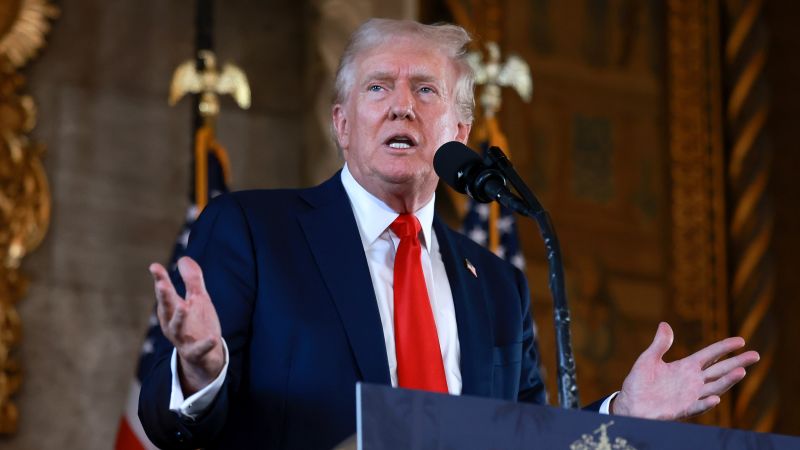
Throughout his presidency, Donald Trump tried to pressure the Federal Reserve into cutting rates — a breach of protocol that threatened to undermine the independence of the central bank and its ability to keep jobs booming and inflation low. If reelected, Trump said Thursday he’d go further: He’d try to exert direct power over monetary policy. “I feel the president should have at least a say in there. I feel that strongly,” Trump said toward the end of his press conference. “I made a lot of money. I was very successful. And I think I have a better instinct than, in many cases, people that would be on the Federal Reserve — or the chairman.” The former president said that Fed Chair Jerome Powell, whom Trump appointed to the position in 2017, has got the timing of rate moves wrong throughout his tenure. “He’s tending to be a little bit late on things. He gets a little bit too early and a little bit too late,” Trump said. “I believe it’s really a gut feeling.” Trump appeared to be joining a growing chorus, including economists and market participants, who believe Powell and the Fed blew it last week when it opted not to cut rates from a 23-year high at the conclusion of its policy meeting on July 31. Two days later, the US Bureau of Labor Statistics reported that the US economy added a disappointing 114,000 jobs and the unemployment rate shot up to 4.3%. That worse-than-expected jobs report sent the stock market into a tizzy, igniting fears that the Fed waited too long to cut rates. It takes time for rate hikes or cuts to take effect in the economy, so timing a policy decision right is a tricky game that the Fed historically has failed to win.


Lululemon Athletica said on Thursday that its CEO, Calvin McDonald, will step down in January, after about seven years at the helm as the yogawear maker navigates a challenging consumer environment in the United States as well as growing competition from newer brands.

Wall Street got the rate cut it wanted. But with the Federal Reserve set to take a more cautious approach to trimming interest rates in 2026, investors are now left to wrestle with other concerns that had been put on the back burner while Fed rate cuts were top of mind.

Time has announced that the “architects of AI” are its Person of the Year. Certainly, AI is wrapping up an extraordinary year, and many AI business executives have become household names.

Disney is taking a $1 billion equity stake in OpenAI, while also striking a deal that would allow its famous characters be used on Sora, the AI company’s video generation platform.

The main reason Americans are upset about the economy: They are still adjusting to high prices that surged during years of runaway inflation that took place during former President Joe Biden’s term.

AI-generated videos showing what appear to be underage girls in sexualized clothing or positions have together racked up millions of likes on TikTok, even though the platform’s rules prohibit such content, according to new research from an online safety non-profit.

President Donald Trump is blaming his predecessor Joe Biden for the affordability crisis that is roiling the US economy – and politics.

There are signs steeper US tariffs, introduced by US President Donald Trump, are feeding through to higher prices for Americans. But they are also inflicting pain beyond US borders. We look at examples from around the world.

Just a year ago, Chinese manufacturers, fearing a new trade war, rushed to push out exports following the election victory of President Donald Trump, who had pledged to slap punishing tariffs on imports from China over America’s widening trade deficit with the country.

President Donald Trump has a few tried-and-true rhetorical strategies. He invokes what “many people are saying” when he needs to make an unsubstantiated claim. He riffs on nicknames for his political enemies. And he repeats a talking point relentlessly, hoping it’ll stick in people’s minds.

Paramount and Netflix are in a vicious tug-of-war over Warner Bros. Discovery.

The Fed is expected to cut interest rates Wednesday by a quarter point, lowering borrowing costs for the third time this year to support a weakening labor market. Follow for live news updates.

A new pro-AI network of political action committees is releasing its first candidate ads in the 2026 midterms, as the debate around artificial intelligence ramps up ahead of the elections.