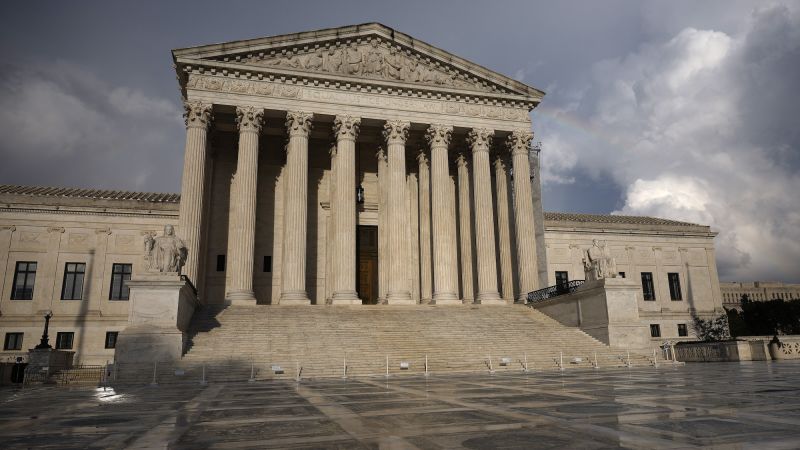
The Supreme Court is sowing confusion over how it will handle election disputes this fall
CNN
The recent Supreme Court decision changing voter registration rules in Arizona has voting rights advocates anxious about how the justices will approach emergency election appeals in the runup to the November election.
The recent US Supreme Court decision changing voter registration rules in Arizona has voting rights advocates anxious about how the justices will approach emergency election appeals in the runup to the November election. Not only was the Arizona ruling a missed opportunity for the justices to explain when they will engage in election and voting cases, experts say it has also heightened concern that the court is unevenly applying a murky legal principle intended to reduce chaos rather than add to it. The “Purcell principle,” rooted in a 2006 Supreme Court decision, warns federal courts to avoid making last minute changes to the status quo of voting rules before an election. But 18 years later, what counts as “status quo” and “last-minute” still remains up for debate. That lack of clarity – and what critics see as an inconsistent application of the doctrine – could be a critical factor in this year’s election. The Arizona ruling “is creating additional uncertainty around a principle that already had very few concrete parameters,” said Sophia Lin Lakin, director of the ACLU’s Voting Rights Project. “It’s hard to understand exactly what the court is doing when it comes to Purcell and that creates a lot of anxiety that the rule could be applied in a way that’s inconsistent and tips the scales one way or the other.” Rather than clarifying Purcell in its order in the Arizona citizenship voting registration case, critics say the justices managed to muddy the water by avoiding it altogether.


In his latest effort to lower drug costs, President Donald Trump unveiled Friday “Most Favored Nation” pricing deals with nine more pharmaceutical companies.

At least seven Colombian soldiers were killed and 30 wounded Thursday when a guerrilla group attacked an Army base with drones and explosives, the military said.

The Supreme Court on Friday sided against the Trump administration, keeping alive a federal lawsuit from immigration judges who are attempting to challenge a policy that limits their ability to speak publicly.

The Department of Homeland Security announced its intention to pause a visa program intended to admit certain individuals to the United States, though it’s unclear whether it’s been suspended entirely.

New signage is being installed at Washington, DC’s performing arts center on Friday to include President Donald Trump’s name.

A simmering battle over the future of President Donald Trump’s political movement exploded on one of the right’s biggest stages Thursday, as prominent conservative influencers used Turning Point USA’s annual youth conference to attack each other and their competing visions.

A recently enacted US House map would again make Troost Avenue a dividing line in the community, part of a plan to have Democratic-leaning Kansas City represented by three separate Republican lawmakers.

How should a military commander respond if they determine they have received an unlawful order?

The White House is heading into a critical midterm year beset by economic challenges, as it tries to manage stubbornly high prices, a frustrated electorate and a commander-in-chief who struggles to show sympathy toward voters’ pain.

Congressional Republicans have sent lawmakers home for the holidays without voting to address the Obamacare subsidies cliff that will hit millions of Americans on New Year’s Day — infuriating some of their own rank and file.

A jury found a Wisconsin judge – accused of helping an undocumented immigrant dodge federal authorities – guilty of obstruction Thursday, marking a victory for President Donald Trump as he continues his sweeping immigration crackdown across the country.

A number of Jeffrey Epstein survivors voiced their concern in a private meeting with female Democratic lawmakers earlier this week about the intermittent disclosure of Epstein-related documents and photos by Democrats on the House Oversight Committee, sharing that the selective publication of materials was distressing, four sources familiar with the call told CNN.

The US military conducted strikes against two alleged drug-trafficking boats in the eastern Pacific Ocean on Thursday, killing 5 people, according to US Southern Command.