Telangana had more preventable C-sections among southern States Premium
The Hindu
Study reveals preventable C-section rates in southern Indian states, highlighting risks and trends in maternal healthcare practices.
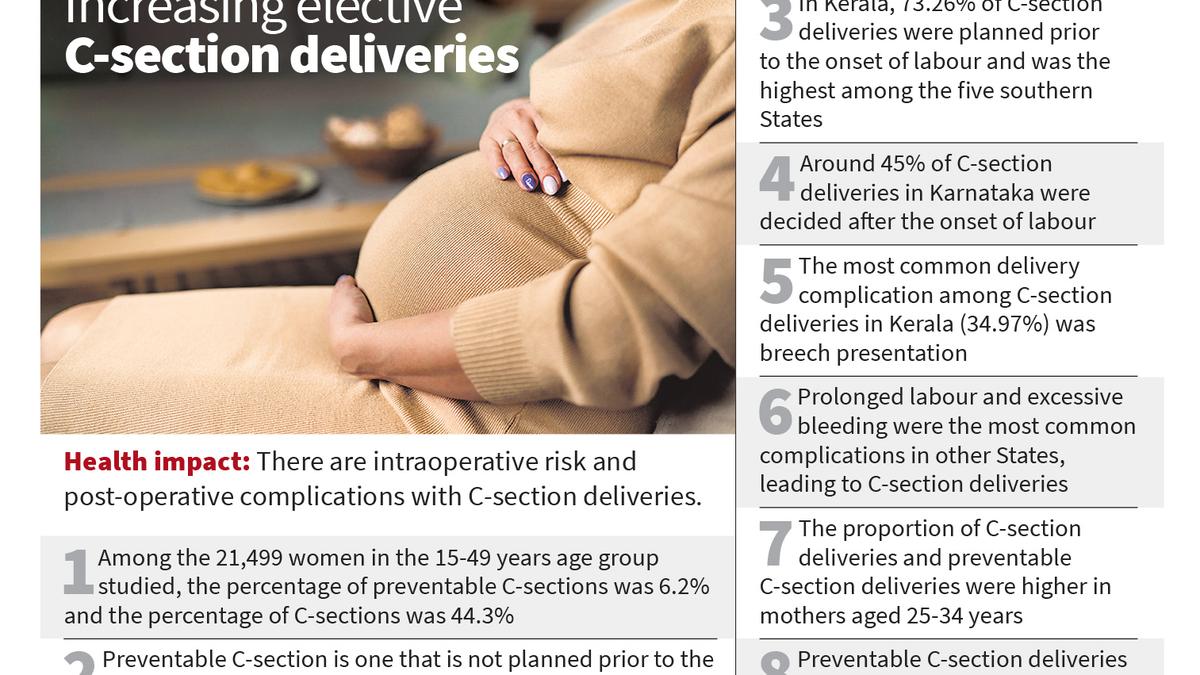
A study found that preventable Caesarean sections or C-sections constitute between 3.1% and 8.4% of all deliveries in the southern States of Andhra Pradesh, Kerala, Karnataka, Tamil Nadu, and Telangana. Among the 21,499 women studied, the percentage of preventable C-sections was 6.2%, and the percentage of C-sections was 44.3%. The percentage of preventable C-sections among overall C-section deliveries was 13.9%.
At 3.1%, Kerala had the lowest number of preventable C-sections, while Telangana had the highest at 8.4%. Preventable C-sections were 5.4% for Andhra Pradesh, 6.2% for Karnataka, and 7% for Tamil Nadu. Preventable C-section was defined as a C-section delivery that was not planned prior to the onset of labour, conducted at full term, and done without any intrapartum complications such as breech presentation, transverse lie, prolonged labour, and excessive bleeding. The classification was based on gestational age, mode of delivery, timing of the decision, and absence of intrapartum complications. Besides high out-of-pocket expenses, preventable C-sections result in “inefficient use of health system resources, intraoperative risk, and post-operative complications that impact the mother’s and child’s future health and well-being”, notes the study.
The study included 21,499 women in the age group 15-49 years who had given birth within the last five years. Data from the National Family Health Survey-5 was used in this study. The study was published on April 23, 2025 in the journal PLOS ONE.
At 96.5%, institutional deliveries are indeed high in the southern States and comparable with some of the countries in Western Europe and North America. These States also have substantially higher percentage of C-section deliveries — 31.5% to 60.7% — possibly due to high percentage of institutional deliveries.
In Kerala, 73.26% of C-section deliveries were planned prior to the onset of labour and were the highest among the five States studied. While deciding on C-sections before the onset of labour does indicate access to high-quality antenatal care, it might also reflect that a significant proportion of mothers might be opting for an elective C-section. Compared with Kerala, around 45% of C-section deliveries in Karnataka were decided after the onset of labour, the study carried out by Population Council Consulting, New Delhi, AIIMS Delhi, and TISS, Mumbai found.
The most common delivery complication among C-section deliveries in Kerala (34.97%) was breech presentation, while prolonged labour and excessive bleeding were the most common complications in other States. Excessive bleeding was the most common complication observed in Andhra Pradesh and Telangana. According to the study, the risk of post-partum haemorrhage is strongly associated with the absence of antenatal care — full antenatal care coverage (i.e., at least four antenatal care visits) was lowest in Andhra Pradesh and Telangana compared with the other three southern States.
The study found that the proportion of C-section deliveries, as well as preventable C-section deliveries, was higher in mothers aged 25-34 years. “Mothers with higher education — primary schooling and above — have at least a 30% greater chance of undergoing a preventable C-section compared to those without education,” they write. “Higher prevalence was found among uninsured, richer, and unemployed women, and higher preventable C-sections were found to occur with increased antenatal care visits and in private health care facilities.”


Discover why spicy food causes a runny nose and how capsaicin triggers a protective response in our bodies.

In October this year, India announced its intention to build Maitri II, the country’s newest research station in Antarctica and India’s fourth, about 40 forty-odd years after the first permanent research station in Antarctica, Dakshin Gangotri, was established. The Hindu talks to Dr Harsh K Gupta, who led the team that established it

Study reveals rising artemisinin resistance in Africa, echoing Asia's past, urging urgent action to prevent widespread crisis.

Michelin launches The Grappe, a new wine distinction, recognizing excellence with one to three grapes, starting with the Burgundy and Bordeaux regions

A groundbreaking experiment transforms skin cells into egg-like cells, offering hope for infertility treatments amidst ethical considerations.

Discover Niraba, a collaboration merging Odisha's sabai grass weaving and dhokra craft into contemporary furniture and lighting design.

How do you create a Christmas tree with crochet? Take notes from crochet artist Sheena Pereira, who co-founded Goa-based Crochet Collective with crocheter Sharmila Majumdar in 2025. Their artwork takes centre stage at the Where We Gather exhibit, which is part of Festivals of Goa, an ongoing exhibition hosted by the Museum of Goa. The collective’s multi-hued, 18-foot crochet Christmas tree has been put together by 25 women from across the State. “I’ve always thought of doing an installation with crochet. So, we thought of doing something throughout the year that would culminate at the year end; something that would resonate with Christmas message — peace, hope, joy, love,” explains Sheena.

Max Born made many contributions to quantum theory. This said, he was awarded the Nobel Prize for physics in 1954 for establishing the statistical interpretation of the ____________. Fill in the blank with the name of an object central to quantum theory but whose exact nature is still not fully understood.

Join the Moms of Kochi for the Purple Carnival, a vibrant lifestyle exhibition featuring stalls, competitions, and entertainment on December 13-14.

Human-rating emerges as a crucial process ensuring that space systems like LVM-3 can safely carry humans by adding redundancy, robust abort capabilities, and rigorous testing

Discover how golden apple snails' eye regeneration offers insights into restoring human vision through genetic understanding and CRISPR technology.

Discover how microwave ovens can superheat water, leading to unexpected boiling when disturbed. Stay safe while heating.

INDN has launched in NYC’s NoMad. Indian food goes 21+ here, with savoury cocktails, nostalgic small plates and a bar that refuses desi clichés — much to one dad’s horror