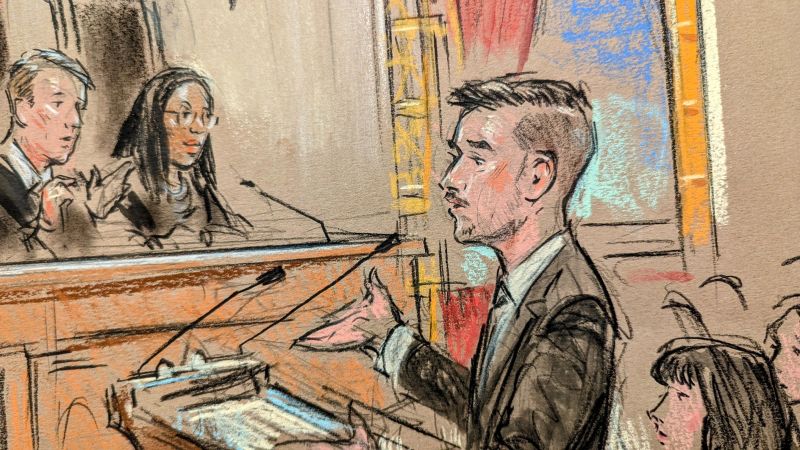
Takeaways from the historic transgender care arguments at the Supreme Court
CNN
The Supreme Court appeared likely to back a divisive Tennessee law that bans gender-affirming care for minors after more than two hours of oral arguments on Wednesday in which the court delved into a culture war battle that has become even more politically fraught since the election.
The Supreme Court appeared likely to back a divisive Tennessee law that bans gender-affirming care for minors after more than two hours of oral arguments on Wednesday in which the court delved into a culture war battle that has become even more politically fraught since the election. Several conservative justices – notably Chief Justice John Roberts and Justice Brett Kavanaugh – signaled deep reservations with the idea of courts second-guessing lawmakers who have approved bans on puberty blockers and hormone therapy for minors in roughly half of the nation’s states. The court’s three liberal justices appeared to be aligned in favor of the trans youth and their parents who challenged the Tennessee law and the Biden administration in saying that transgender Americans should receive heightened protection under the law. And one key conservative – Justice Neil Gorsuch – was notably silent. The transgender care case is the most significant matter to come before the Supreme Court this term – and it has become even more extraordinary since former President Donald Trump was elected to a second term, in part on a campaign to end the “transgender craziness.” More than 110,000 teenagers live in states where restrictions on transgender care exist, according to the Williams Institute at UCLA School of Law. Here’s what to know from Wednesday’s historic arguments:


In the hours after police discovered the bodies of Rob Reiner and Michele Singer Reiner inside their Brentwood, California, home, speculation was rife over what could have led someone to murder the beloved Hollywood director and his other half, a charismatic photographer and producer.

President Donald Trump came to North Carolina on Friday to talk about the economy.

The Justice Department released thousands of files related to sex offender and accused sex-trafficker Jeffrey Epstein in a much-anticipated document dump Friday.

Texas judge orders Attorney General Ken Paxton’s divorce records unsealed amid heated Senate primary
Court documents detailing the divorce of Republican U.S. Senate candidate and Texas Attorney General Ken Paxton and his wife, state Sen. Angela Paxton, were released Friday by order of a judge, months after she filed citing “biblical grounds.”

An oil and chemical tanker sanctioned by the United States has entered Venezuelan waters, ship tracking data showed, despite US President Donald Trump declaring a “total and complete blockade” of such vessels transiting the country.

The Justice Department’s partial release of its files related to Jeffrey Epstein on Friday marked a moment of triumph for Epstein survivor Maria Farmer and her sister Annie, who have said for years that Maria had filed one of the first complaints against Epstein in the 1990s.

‘Twas the week before Christmas in a Montreal store, when Santa stole groceries, then walked out the door.

The US struck multiple targets in Syria on Friday that the US military tied to ISIS as retaliation for the recent attack against American troops there that killed two service members, according to two US officials.

CNN is tracking delays and cancellations for flights traveling to, from or within the US using data from FlightAware. Data updates every 15 minutes.

Republican Rep. Elise Stefanik announced Friday she was ending her short-lived bid for governor of New York and would not run for another term in Congress.

In his latest effort to lower drug costs, President Donald Trump unveiled Friday “Most Favored Nation” pricing deals with nine more pharmaceutical companies.

At least seven Colombian soldiers were killed and 30 wounded Thursday when a guerrilla group attacked an Army base with drones and explosives, the military said.

The Supreme Court on Friday sided against the Trump administration, keeping alive a federal lawsuit from immigration judges who are attempting to challenge a policy that limits their ability to speak publicly.