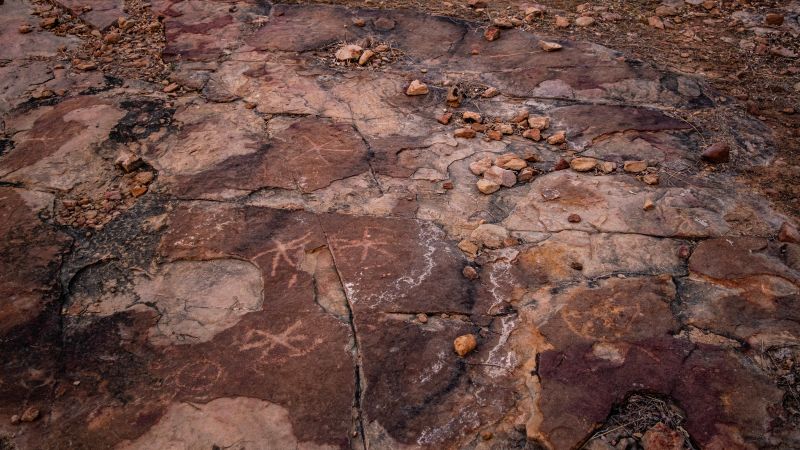
Strange prehistoric drawings found near dinosaur footprints in Brazil
CNN
Prehistoric humans in Brazil carved drawings in the rock next to dinosaur footprints, suggesting they may have found them meaningful or interesting, a study found.
Prehistoric humans in Brazil carved drawings in the rock next to dinosaur footprints, suggesting that they may have found them meaningful or interesting, a new study has found. The rock carvings, which archaeologists call petroglyphs, are at a site called Serrote do Letreiro in Paraíba, an agricultural state on the eastern tip of Brazil. Researchers first observed the marks in 1975. But they are now interpreted as relating to the footprints following recent field surveys aided by drones, which uncovered previously unseen carvings. The tracks belong to dinosaurs from the Cretaceous Period, which ended 66 million years ago. “People usually think that Indigenous people weren’t aware of their surroundings or didn’t have any kind of scientific spirit or curiosity,” said study coauthor Leonardo Troiano, an archaeologist at the Institute of National Historic and Artistic Heritage in Brasilia. “But that’s not true. It’s very clear that they were interested in the footprints. We’ll never know if they knew about dinosaurs, but it is clear that they were curious about the prints and thought they were meaningful in some way.” The Serrote do Letreiro petroglyphs aren’t the first examples of rock art found close to dinosaur prints, but the authors of the study said they believe that the unprecedented clarity of the association between the two at this particular site could have significant implications across paleontology, archaeology and cultural heritage studies. It’s unclear how long ago the petroglyphs were made. But the study — published in March in the journal Scientific Reports — notes that radiocarbon dating has found burial sites in the area to be between 9,400 and 2,620 years old, suggesting the tribes that left them must have lived during that time. “These people were probably living in small communities, using natural rocky shelters that are very abundant in the area,” Troiano said.


CNN’s 5 Things AM brings you the news you need to know every morning.

For more than a month, a Virginia high school football coach accused of child pornography offenses has remained missing after vanishing from his home without a trace.

They are still the rarest of Republicans – those who have spoken out and stood up to President Donald Trump over the past year, willfully saying something he rarely hears: No.

The Trump administration has signaled to the Smithsonian Institution that the White House could withhold federal funding from the museum organization if it does not comply with the administration’s unprecedented, sweeping review.

This weekend’s gathering of young Republicans and conservative influencers in the Arizona desert offered a glimpse into the divisions already fraying President Donald Trump’s coalition even before its lame-duck leader is out of the picture.

The US is pursuing a vessel in international waters near Venezuela on Sunday after attempting to intercept it, a US official said, as President Donald Trump’s administration tightens its crackdown on the country’s oil industry.

Power was restored Sunday morning to the bulk of the 130,000 homes and businesses in San Francisco impacted by a massive outage on Saturday that caused major disruptions in the city.

When Rep. Dan Goldman first ran for Congress in 2022, he was cheered on the left as the party’s top lawyer during President Donald Trump’s first impeachment.

A dog desperately needing a potty break led Elaine Traverse to find a statue that had been the talk of the town in Canada’s Harbour Grace for months.

Police lights flashed for hours as law enforcement officers surrounded a storage facility in Salem, New Hampshire Thursday night, finally closing in on a suspect who unleashed deadly attacks on two communities and had managed to evade them for six days.

The National Transportation Safety Board is investigating after seven people – including former NASCAR driver Greg Biffle – died when a small private jet crashed shortly after takeoff in Statesville, North Carolina, this week, investigators said Saturday.

Personnel from the United States boarded and seized a vessel off the coast of Venezuela, according to an official familiar with the matter, as the Trump administration ramps up pressure on Caracas.

The Justice Department released thousands of files related to sex offender and accused sex-trafficker Jeffrey Epstein after Congress passed a law forcing the Trump administration to do so.