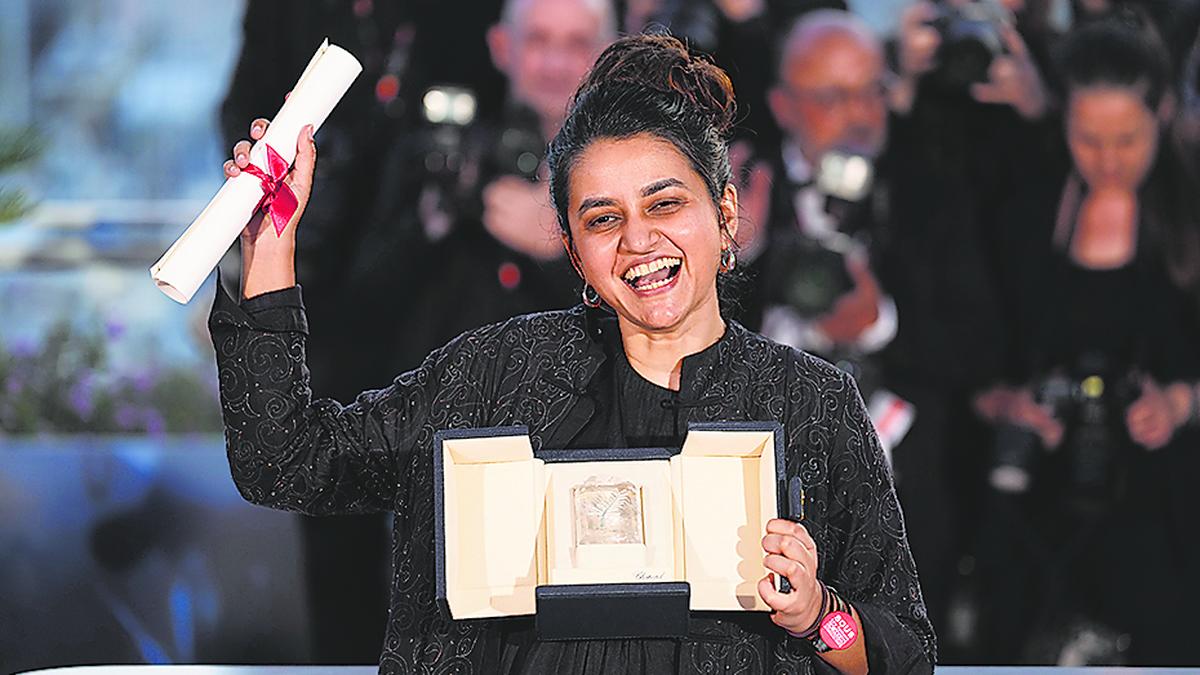
Payal Kapadia, who was on warpath with FTII, earns praise from her alma mater for Cannes win
The Hindu
Kapadia charted history by becoming the first Indian filmmaker to win the Cannes Grand Prix award for ‘All We Imagine as Light’; in 2015, she had led a student protest against the appointment of actor-turned-politician Gajendra Chauhan as FTII chairman
Amid the outpouring of congratulatory messages for Payal Kapadia, who won the second highest honour at the 77th Cannes Film Festival, a message from her alma mater FTII lauding her has garnered much attention.
At the gala, which concluded on Saturday, Kapadia charted history by becoming the first Indian filmmaker to win the Grand Prix award for All We Imagine as Light.
On Sunday, the Film and Television Institute of India in a post on X said it is a moment of pride for the FTII as its alumni create history at Cannes and congratulated Kapadia for the award.
Back in 2015, Kapadia was on the warpath with the Film and Television Institute of India (FTII).
She had led a student protest against the appointment of actor-turned-politician Gajendra Chauhan, best known for his portrayal of Yudhisthir in the mega TV serial Mahabharat, as the chairman of the Pune-based premier institute.
According to the protesting students, Chauhan did not match the vision and stature of past chairmen of the FTII governing council, and his appointment appeared “politically coloured”.
During the 139-day strike, the students also allegedly gheraoed and confined the then FTII Director Prashant Pathrabe in his office over some academic issues. This had led to the police entering the campus and arresting some of the protesters.


Singer Tanvi Shah returns to music with 'Baala Kaale', a Sinhalese song that marks a quiet, hopeful comeback.

The makers of the Sivakarthikeyan-starrer Parasakthi have unveiled a grand exhibition at Valluvar Kottam in Chennai that displays the many period sets that were created for the film

The trailer of Vir Das' Happy Patel Khatarnak Jasoos, backed by Aamir Khan and also starring Imran Khan, was unveiled

Filmmaker Prakash Veer just pulled off a major feat with the release of ‘The Devil’, his action-thriller featuring superstar Darshan, all while the actor was dealing with some serious legal drama

Dhurandhar exemplifies government-embedded filmmaking, blending patriotism with a one-dimensional portrayal of Pakistan in contemporary cinema.

Solve The Hindu Sunday crossword no. 35 with intriguing clues across and down for a fun challenge!

In its 10th edition Serendipity Arts Festival foregrounds food-themed projects and commentaries on surveillance, migration, ecology and erasure

Test your crossword knowledge with intriguing trivia and puzzles inspired by their rich history and clever wordplay.

A vacuum cleaner haunted by a ghost is the kind of one-liner which can draw in a festival audience looking for a little light-hearted fun to fill the time slots available between the “heavier” films which require much closer attention. A useful ghost, the debut feature of Thai filmmaker Ratchapoom Boonbunchachoke being screened in the world cinema category at the 30th International Film Festival of Kerala (IFFK), even appears so in the initial hour. Until, the film becomes something more, with strong undercurrents of Thailand’s contemporary political history.

Kochi News:Watch: Kochi-Muziris Biennale 2025 opens across 22 venues

Sustainability is not an add-on, but stamped firmly into the process: every piece is biodegradable, waste-free and unembellished, free from glitter or beads. “Products should be sustainable and biodegradable so that our planet is not harmed,” says Anu Elizabeth Alexander, a student of Sishya, Adyar. At a recent exhibition, the stars she made sold the fastest, followed by the small diamonds. “I would like people to know about the process, how it is created, and that it is sustainable,” says Anu. Infanta Leon from Kotturpuram developed an interest in crochet as a teenager. It was a hobbyhorse that evolved into a steed that would help her embark on a journey of identity-shaping creative engagement. She started making Christmas-themed decor two years ago, spurred by a desire to craft safe, eco-friendly toys for children. “With a toddler at home, and my elder child sensitive to synthetic materials, I wanted to create items that were gentle, durable and tactile,” she explains. Her earliest creations were small amigurumi toys which gradually evolved into ornaments that could adorn Christmas trees with warmth and charm.

Test your knowledge of Stranger Things with our quiz ahead of the final season premiere!

Studio Bones’ new shounen, Gachiakuta, based off Kei Urana's manga, is a blitz of anarchy in animation, turning society’s discarded into a swirl of stylised rebellion