Lakmé Fashion Week 2025 trend report: Menswear, sustainability, and everyday luxury
The Hindu
Lakmé Fashion Week 2025 showcased a shift towards thoughtful, sustainable fashion with a focus on craftsmanship and wearability.
In its 25th year, the Lakmé Fashion Week 2025, in partnership with the Fashion Design Council of India (FDCI) was less about spectacle and more about sensibility. Theatrics took a backseat to thoughtfulness, as designers re-evaluated what fashion means in a climate of change — climatic, cultural, and consumer-driven. There was no singular aesthetic dominating the five-day showcase, but rather a quiet recalibration of technique, proportion, and intent.
From seasoned couturiers to new-gen labels, the collections spoke of dualities — tradition meeting tech, comfort meeting structure, and art meeting wearability. Instead of chasing virality, designers leaned into craft. Surface embellishment was purposeful. Colour palettes were restrained. Gender norms blurred. Heritage, once treated with nostalgia, was now layered with a future-facing lens.
Refined maximalism
While the West continues to orbit around quiet luxury, Indian designers at Lakmé Fashion Week offered a counterpoint — maximalism, but measured. It was a season of drama laced with discipline; ornamentation wielded with intent.
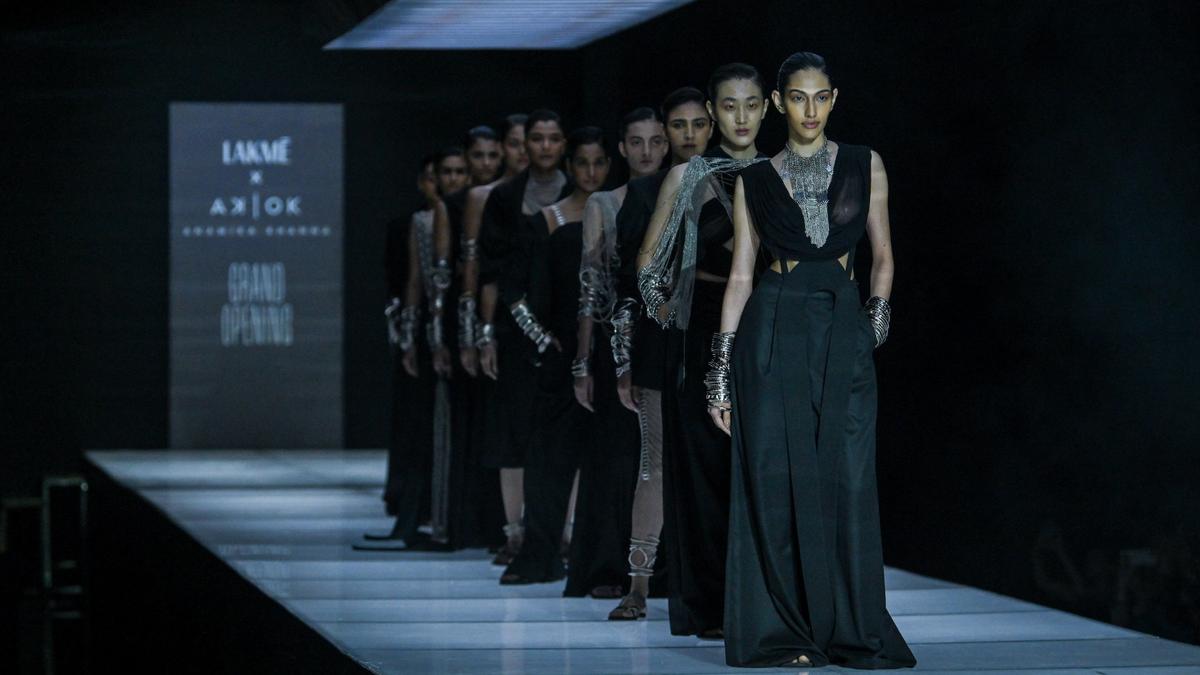
Anamika Khanna’s Silver Collar collection set the tone. Deconstructed tailoring met opulent embroidery — structured bralettes, high-waisted metallic trousers, and chainmail flourishes. It was less about flamboyance, and more about confidence laced with craft.
Rahul Mishra’s The Silk Route, under his prêt label AFEW, drew from flora, folklore, and textile legacies. The collection wove Nature into couture, presenting hand-embroidered ecosystems that rippled with detail but never tipped into excess. The intricacy was intense, but the message — sustainability and quiet wonder — came through loud and clear. The collection highlighted visual exchanges across borders, mirrored in the parallel evolution of India’s bandhani and Japan’s shibori. A quiet ode to craft, culture and shared histories.
Amit Aggarwal took maximalism in a futuristic direction. His collaboration with tech brand Nothing resulted in a line where Banarasi brocade collided with industrial polymers — ballooning trousers, corseted blouses, and sharp tailoring gave tradition a glossy, sci-fi sheen. The palette was monochrome, but the craftsmanship spoke volumes.


Discover Niraba, a collaboration merging Odisha's sabai grass weaving and dhokra craft into contemporary furniture and lighting design.

How do you create a Christmas tree with crochet? Take notes from crochet artist Sheena Pereira, who co-founded Goa-based Crochet Collective with crocheter Sharmila Majumdar in 2025. Their artwork takes centre stage at the Where We Gather exhibit, which is part of Festivals of Goa, an ongoing exhibition hosted by the Museum of Goa. The collective’s multi-hued, 18-foot crochet Christmas tree has been put together by 25 women from across the State. “I’ve always thought of doing an installation with crochet. So, we thought of doing something throughout the year that would culminate at the year end; something that would resonate with Christmas message — peace, hope, joy, love,” explains Sheena.

Max Born made many contributions to quantum theory. This said, he was awarded the Nobel Prize for physics in 1954 for establishing the statistical interpretation of the ____________. Fill in the blank with the name of an object central to quantum theory but whose exact nature is still not fully understood.

Join the Moms of Kochi for the Purple Carnival, a vibrant lifestyle exhibition featuring stalls, competitions, and entertainment on December 13-14.

Human-rating emerges as a crucial process ensuring that space systems like LVM-3 can safely carry humans by adding redundancy, robust abort capabilities, and rigorous testing

Discover how golden apple snails' eye regeneration offers insights into restoring human vision through genetic understanding and CRISPR technology.

Discover how microwave ovens can superheat water, leading to unexpected boiling when disturbed. Stay safe while heating.

INDN has launched in NYC’s NoMad. Indian food goes 21+ here, with savoury cocktails, nostalgic small plates and a bar that refuses desi clichés — much to one dad’s horror

EU scientists predict 2025 will be among the hottest years on record, highlighting urgent climate change concerns and inadequate global action.

Explore the complete review of the 2025 Tata Sierra, India’s reborn SUV icon. From its standout design and premium cabin to refined petrol and diesel engines, advanced tech and competitive pricing, this in-depth breakdown reveals why the new Sierra is poised to lead the midsize SUV segment.

Elon Musk’s SpaceX is moving ahead with plans for an initial public offering that would seek to raise significantly more than $30 billion and target a valuation of about $1.5 trillion, Bloomberg News reported

Aditya-L1 and U.S. satellites uncover why the May 2024 solar storm behaved unusually, revealing significant magnetic field dynamics.

Harley-Davidson X440T introduces updated rider aids, refined performance and refreshed styling, offering a modern, city-focused evolution of the successful X440.