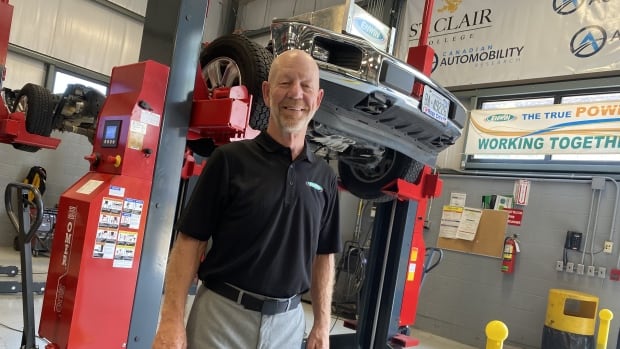
Gas-powered truck gutted, being converted into all-electric 'showcase piece' in Windsor, Ont.
CBC
In just a few weeks, an Enwin Utilities truck that was once gas-powered will be fully transformed into an all-electric vehicle ready to hit the road.
A small team, including students from St. Clair College, completely gutted the vehicle's innards, removing the 3.5-litre gas engine from the 2018 Ford F-150 and replaced it with eight massive batteries that will make it run. It's a partnership between Enwin, Canadian Automobility Enterprises and St. Clair College.
"It's invaluable in terms of what we're learning," said Barry Leavitt, Enwin's director of corporate operations and innovation. "We have to be prepared for the implementation of an electric fleet over the next five to 10 years. As our fleet becomes aged and we replenish, we need to be prepared for the electric platforms."
The auto mechanics installed the electric engine on Wednesday after beginning the retrofit roughly one month ago.
After removing the connection points between the body of the truck and the chassis, the truck was essentially hoisted apart into two pieces.
In a few months, after the testing phase, Enwin expects to put the vehicle to use in day-to-day operations, which will make it the organization's first fully-electric vehicle. Acceleration, towing capacity, battery range, performance are all areas they'll monitor when it's in use.
It's being described as a "showcase piece," according to Rafal Bulgarski, general manager of Canadian Automobility Enterprises.
This is the first project of its kind for the private firm that announced its arrival in Windsor, Ont., last year. It's a joint venture created by people with local experience in the automotive manufacturing, mould making, IT development and electric vehicle production.
"It's beyond the regular project where here's a vehicle, it's fun. It's actually going to be a use case that will allow us to understand how practical this vehicle will be in the field," said Bulgarski.
He believes there's a market to have traditional gas-powered vehicles converted into EVs, instead of building them from scratch, which he admits is "probably a little bit more logical."
"But, in the industry, a lot of these vehicles have a long lifetime and it doesn't make sense that these vehicles would not be converted in order to still get the same benefits of an electrical system," said Bulgarski. "I think there is this transition period where this is absolutely the right thing to do."
Normally, car makers need to jump through a number of regulatory hoops before a vehicle is deemed road worthy, including crash testing. But since they're leaving most of the truck intact, it will jump through fewer hoops.
"There's no requirement on us to do further testing beyond ensuring the systems that have been mildly touched, still function," said Leavitt, referring to anti-lock braking, power steering as well as the heating and cooling systems.
One concern they're working to address is the ability for fully electric Enwin vehicles being able to survive a long-term power outage, as some communities in Ontario experienced in May.


Police services across northern Ontario say most illicit drugs circulating in their communities are being transported from southern parts of the province, while prescription drugs diverted into the illegal market continue to pose a serious and ongoing threat.

The case of a child who was killed by his mother shortly after being returned from foster care has shed a rare and needed spotlight on the child welfare system, say experts in the field.

G.E. Barbour may be best known for its King Cole tea, but the Sussex company’s peanut butter is apparently what everyone wants overseas.

Seven years into an early onset Alzheimer’s diagnosis, Sandra Demontigny's home is full of reminders.

A blizzard gusting across southern Manitoba is leaving a long list of highway and school closures.

While a blizzard threatened outside, Saskatoon city council endured an icy blast inside city hall from a Riversdale business leader over its homeless initiatives.

This is a story about fire, faith and marshmallows.

Alberta’s population bucked the trend that almost every other Canadian province and territory experienced last quarter, Statistics Canada population estimates suggest.

A U.S. judge on Wednesday blocked Michigan from enforcing a 2020 order to shut down Enbridge's Line 5 oil pipeline running beneath a channel linking two of the Great Lakes, ruling that pipeline safety is a federal responsibility.

When retired RCMP constable Jason Hydamacka heard the news that the insurance money for his amputated leg was coming, he sat in his truck and cried.

As Neskantaga First Nation’s youngest band councillor, Lashaunda Waswa says she wants to inspire the next generation to protect the community’s land, water and wildlife.

Toronto has seen a drop in crime rates across the city, but its police chief says youth crime rates continue to be a cause for concern.

Cambridge council has voted to request a pedestrian safety review of Cedar Street from the region after two back-to-back collisions last week, one of which killed a three-year-old girl.