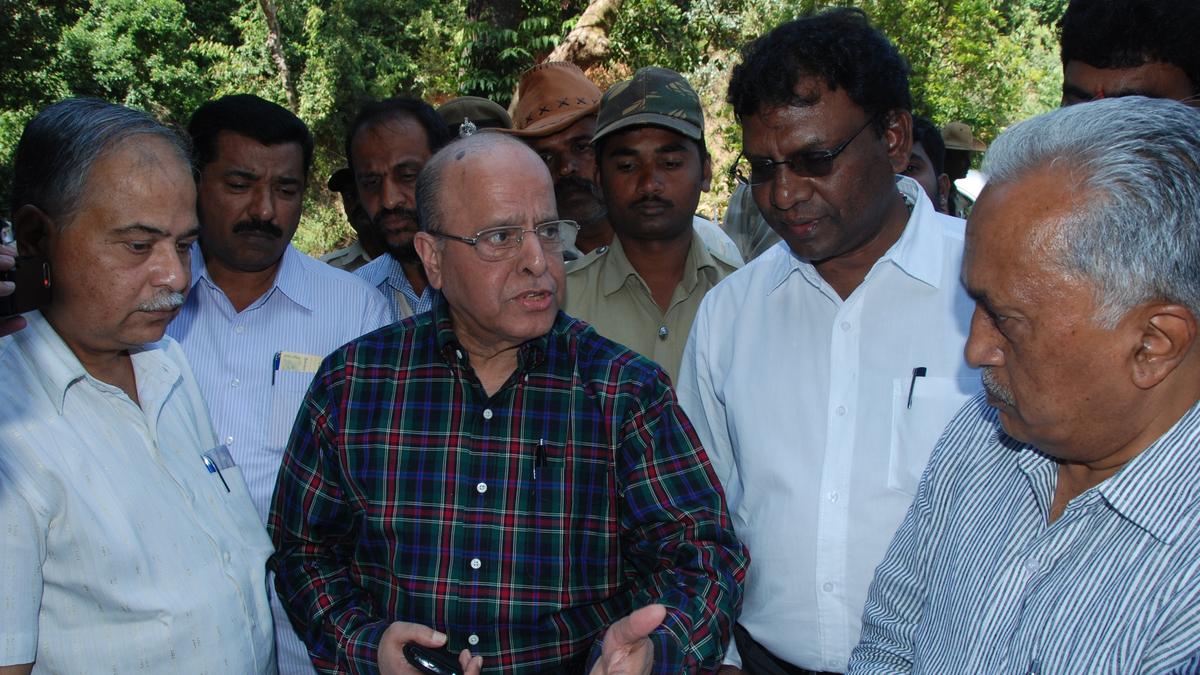
Former ISRO chairman K. Kasturirangan no more
The Hindu
Besides a stellar career in the space programme, he was the author of the Kasturirangan Committee report on Western Ghats, which in 2013, identified an area of 59,940 sq. km of natural landscape of Western Ghats, spread across Karnataka, Gujarat, Goa, Tamil Nadu, Kerala and Maharashtra as ecologically sensitive.
Former ISRO chairman Dr. K Kasturirangan passed away in Bengaluru on April 25. He was 84 years old.
According to a statement from ISRO: “Dr. K. Kasturirangan has left for heavenly abode this morning at 10. 43 am at his residence in Bengaluru. His body will be kept in RRI for paying last respects on Sunday April 27th from 1000- 1200 hrs.”
Dr. Kasturirangan served as the fifth chairman of ISRO between 1994-2003, and also as the Secretary, Department of Space for over nine years.
During his four-decade-long career in ISRO, he was part of several key missions. He was the project director of India’s first two experimental earth observation satellites BHASKARA-I & II. He steered the first operational Indian Remote Sensing satellite IRS-1A.
A recipient of Padma Shri, Padma Bhushan, and Padma Vibhushan, Dr. Kasturirangan got his Bachelor of Science with Honours and Master of Science degrees in Physics from Bombay University. He received his Doctorate Degree in Experimental High Energy Astronomy in 1971 while working at the Physical Research Laboratory, Ahmedabad.
When he served as ISRO chairman, the Polar Satellite Launch Vehicle (PSLV) was launched and operationalised. The first successful flight testing of Geosynchronous Satellite Launch Vehicle (GSLV) took place unders hip his leadership.
ISRO states that as the Director of ISRO Satellite Centre, he oversaw the activities related to the development of new generation spacecraft, Indian National Satellite (INSAT-2) and Indian Remote Sensing Satellites (IRS-1A & 1B), as well as scientific satellites.


The Centre has rejected reports that the definition of the Aravalli hills was changed to permit large-scale mining, citing a Supreme Court-ordered freeze on new leases. It said a court-approved framework will bring over 90% of the Aravalli region under protected areas and strengthen safeguards against illegal mining. The clarification follows controversy over the “100-metre” criterion used to define hills across states.

Vizag passionately supports the 'Women in Blue' as they triumph in the first T20 match against Sri Lanka.

Suspended MLA Humayun Kabir plans to launch a new political party, aiming to unite marginalized groups in West Bengal.

Udupi police arrest Hirendra Kumar in a Navy ship spying case, making the third arrest linked to unauthorized information sharing.

Bengal police caution against misleading comparisons of murders to prevent communal unrest and ensure public order.

Newly elected local body members take oath in Kochi, celebrating their victories and marking the start of crucial political responsibilities.

9,865 candidates appear for written test for recruitment of SI held in Madurai district

Shorts News:Watch: Festive crowds return to Shimla, but snowfall remains elusive

BJP leader Nainar Nagenthran warns Tamil Nadu ministers of potential jail time, citing Arvind Kejriwal's plight and criticizing DMK.

The 11th CREDAI Property Expo in Visakhapatnam attracted over 14,000 visitors, showcasing 850 projects and fostering buyer-developer interactions.

J&K Congress leader Tariq Hamid Karra protests against removing Gandhi's name from MGNREGA, emphasizing his enduring legacy in people's hearts.

TCS will launch a Delivery Centre in Visakhapatnam in January 2026, creating 2,000 jobs with ₹80 crore investment.

Jammu youth address pressing issues like reservation, unemployment, and social injustice at PDP’s Gal Baath initiative conference.