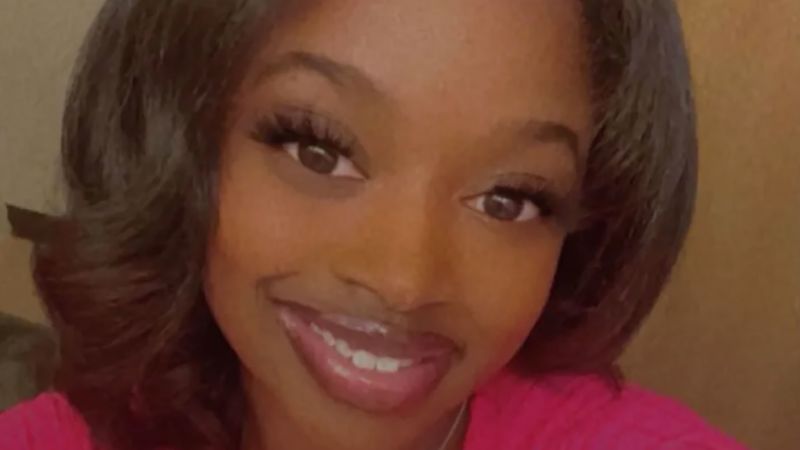
Blood found in suspect’s home does not match mutilated college student Sade Robinson, amended complaint says
CNN
The blood evidence found in the home of Maxwell Anderson, the man accused of killing and mutilating 19-year-old Sade Robinson, does not match the college student’s DNA, according to an amended complaint obtained by CNN affiliate WDJT.
Blood evidence found in the home of Maxwell Anderson, the man accused of killing and mutilating 19-year-old Sade Robinson in Wisconsin, does not match the college student’s DNA, according to an amended complaint obtained by CNN affiliate WDJT. Robinson was reported missing on April 2 when she didn’t show up for work following a first date with Anderson, according to the original criminal complaint filed last week. Her car was found on fire the day after the date. Her remains were found on the beach and near where her car was found. Anderson, 33, has been charged with first-degree intentional homicide, mutilating a corpse, and arson of property other than building, in Robinson’s death. In an updated complaint obtained by WDJT Monday, a new footnote in the court document states that the preliminary DNA analysis performed by the Wisconsin Crime Lab “supports the conclusion that there is no support for inclusion of Robinson’s DNA in any of the blood or swabs tested.” The original criminal complaint detailed evidence police said ties Anderson to the crimes, including surveillance video, witness accounts, and phone records. Authorities also found blood in Anderson’s house and “several gasoline containers.” In court Monday, Anderson pleaded not guilty to all charges against him, according to CNN affiliate WDJT.


A dog desperately needing a potty break led Elaine Traverse to find a statue that had been the talk of the town in Canada’s Harbour Grace for months.

Police lights flashed for hours as law enforcement officers surrounded a storage facility in Salem, New Hampshire Thursday night, finally closing in on a suspect who unleashed deadly attacks on two communities and had managed to evade them for six days.

The National Transportation Safety Board is investigating after seven people – including former NASCAR driver Greg Biffle – died when a small private jet crashed shortly after takeoff in Statesville, North Carolina, this week, investigators said Saturday.

Personnel from the United States boarded and seized a vessel off the coast of Venezuela, according to an official familiar with the matter, as the Trump administration ramps up pressure on Caracas.

The Justice Department released thousands of files related to sex offender and accused sex-trafficker Jeffrey Epstein after Congress passed a law forcing the Trump administration to do so.

A judge Friday voided the conviction of one of the two men found guilty of the 2002 killing of Run-DMC star Jam Master Jay, ruling that there wasn’t enough evidence that the man had a motive to kill the hip-hop luminary.

It was like any other business trip for Minnesota frequent flyer Pete Carleton: walk through TSA, fill up the water bottle past security and chat with colleagues at the gate.

Many of the promises Trump made at Turning Point’s AmericaFest last year — including “lower prices,” an end to foreign wars and “generational change” — have yet to materialize.

In the hours after police discovered the bodies of Rob Reiner and Michele Singer Reiner inside their Brentwood, California, home, speculation was rife over what could have led someone to murder the beloved Hollywood director and his other half, a charismatic photographer and producer.

President Donald Trump came to North Carolina on Friday to talk about the economy.

The Justice Department released thousands of files related to sex offender and accused sex-trafficker Jeffrey Epstein in a much-anticipated document dump Friday.

Texas judge orders Attorney General Ken Paxton’s divorce records unsealed amid heated Senate primary
Court documents detailing the divorce of Republican U.S. Senate candidate and Texas Attorney General Ken Paxton and his wife, state Sen. Angela Paxton, were released Friday by order of a judge, months after she filed citing “biblical grounds.”

An oil and chemical tanker sanctioned by the United States has entered Venezuelan waters, ship tracking data showed, despite US President Donald Trump declaring a “total and complete blockade” of such vessels transiting the country.